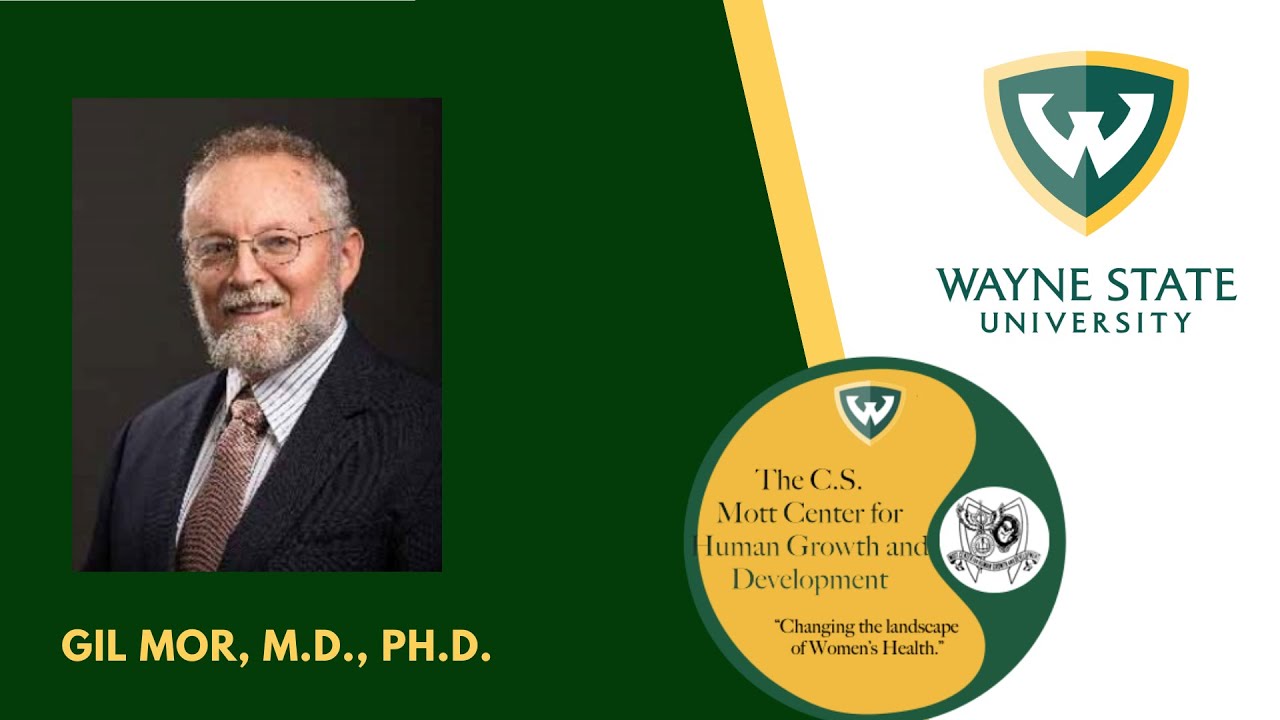
Securing the unique NIH SCORE Grant under Guidance of Dr. Gil Mor
Under the direction of Dr. Gil Mor, MD, PhD, Wayne State University School of Medicine (WSUSOM) has received funding from the National Institutes of Health (NIH) to establish a new Specialized Center of Research Excellence on Sex Differences (SCORE). This unique grant has been historically awarded to Ivy League institutions and now, WSUSOM, making this award a monumental achievement.
With the SCORE grant, Dr. Mor has developed the new center known as Exposome & Pregnancy-Associated Triggers of Host Immunity and Sex-Dimorphic Outcomes (E-PATHs) program. E-PATHS grew out of a fundamental biological question regarding sexual dimorphism (biological differences between males and females) which makes each sex more susceptible to certain clinical outcomes. Historically, this was attributed entirely to sex hormones like estrogen and testosterone. However, sex differences in disease susceptibility manifest in early childhood long before puberty; for instance, boys are more susceptible to viral infections, whereas girls exhibit higher rates of obesity. To study the developmental origins of these differences, scientists at the C. S Mott Center came together, examining how environmental factors like alcohol, PFAs, and viral infections affect male and female development differently. This cross-disciplinary teamwork led to securing the prestigious NIH SCORE grant (Specialized Centers of Research Excellence on Sex Differences).
Dr. Mor's Journey and the Adaptation of Reproductive Immunology
Dr. Mor explained that as an OB/GYN by training and an immunologist by research, he was always fascinated by the biological mystery of why a mother's body does not reject the fetus. His passion for challenging established paradigms led to a pivotal discovery during his time at Yale: pregnancy is not a state of immunosuppression, but rather a period of heightened immunologic adaptation that supports maternal resilience and survival. This adaptation is permanent, given that retained fetal cells carrying paternal genes for the rest of her life.
The Transition to Wayne State and Rebuilding the C.S. Mott Center
Drawing on more than 20 years of experience at Yale University, Dr. Mor was asked during the interview what initially motivated him to transition to a new institution, Wayne State. Admittedly, he stated during his interview that he never expected to leave Yale. However, he was drawn by the C.S. Mott Center for Human Growth and Development of WSUSOM. The center features its own 24,000-square-foot facility and a dedicated clinical resources center. When Dr. Mor arrived in 2019, the center had very few faculty members and virtually no NIH grants except the grant he brought from Yale.
Rebuilding the center offered a powerful opportunity to address Detroit's severe health disparities. More specifically, he saw a need in Detroit's community to be addressed. Detroit has an alarming preterm birth rate of 16%, compared to the national average of 5% and European averages of 3% to 5%. Moreover, the occurrence of a preterm birth in the mother leads to an increased rate of preterm birth in subsequent pregnancies. In addition, mothers who experience preterm birth often pass that physiological vulnerability down to her daughter and granddaughter. Recognizing this as an issue that needed to be investigated and treated, he took on the task of revitalizing the C.S. Mott arts center. Within 6 years, he reorganized the center, growing the faculty to 20 members, securing $32 million in NIH funding (across 17 active grants), and initiating 57 clinical trials.
Reflecting on Successes and Challenges: Building True Scientific Collaboration
Recognizing that research heavily relies on teamwork, Mor was asked which strategies were vital for building successful collaborations. Admittedly, Dr. Mor noted that "collaboration" is a popular term in research, but it is difficult to obtain in practice because researchers often remain isolated due to desiring ownership of their research and its trajectory. To overcome this, Dr. Mor sought to break down individual barriers. He recruited scientists who understood that collective success amplifies individual impact. He assured his team that they would not lose their research autonomy or individual strengths; rather, they were simply adding a sex-difference perspective to enrich their existing research. He jokingly referenced the challenge of inhibiting the human "tribal gene", the natural instinct to associate only with those who think, look, and behave exactly like us, which can be prevalent in academic groups.
International Partnerships and the Philosophy of Shared Knowledge
It has been evident in Mor’s career that both international collaboration and partnerships has always been a priority, evident in awards that he received from various countries as a distinguished researcher. Dr. Mor noted in the interview his shared philosophy of, "Knowledge does not belong to a country, to a race, to a nation or to language. Knowledge belongs to humanity." He stated that governments may attempt to own knowledge, which he believes goes against human nature. Early in his career, he focused on international education to build bridges and counter academic tribalism, traveling globally to lecture. Over his career, he has hosted more than 100 international students in his lab, many of whom have gone on to become deans, department chairs, and leading scientists globally. Additionally, he noted that we are currently living in a highly challenging period where geopolitical tensions are forcing science to be compartmentalized into national boundaries. He called this return to 19th-century-style elite-dominated science "dangerous" because scientific progress in the last 50 to 100 years accelerated precisely because of global, open collaboration.
Academic Models: The United States vs. Europe
Following up on the structure of international partnerships, the conversation touched on the differing academic structures across regions. Dr. Mor compared the European academic system to a pyramid, with a professor at the top of the hierarchy. In contrast, the U.S. model is more egalitarian and linear rather than pyramid-shaped. For example, an assistant professor has the same baseline opportunities and independent standing as a full professor. They do not work “for” a senior professor, which encourages young scientists to bring forward fresh ideas and advance based on their own productivity.
A Successful Philosophy on Mentorship
During the interview, Dr. Mor explained that mentoring is actually the best stimulus to keep himself young and scientifically up-to-date. He approaches mentoring not as a traditional teacher, but as a fellow learner. Rather than delivering lectures or giving out ready-made answers, he challenges his students with tough questions. He stated, "I do not teach. I am not a prophet. I am a learner. I study life." When students ask him questions he doesn't know the answer to, he views it as an exciting challenge to read and research.
Advice to Students and Rejecting Dogma
During the interview, Dr. Mor was asked what advice he would offer to students and early-career investigators aspiring to build meaningful careers in academic medicine and secure major research funding. His central piece of advice was: “Don’t be dogmatic.” He warned that physicians and scientists can sometimes become highly dogmatic, accepting textbook passages as absolute truth without critical thought. Dr. Mor emphasized that there are no dogmas in science, which is why he never uses the phrase “I believe” in scientific discussions. He views knowledge as a collective building, where scientists add bricks, windows, or entire new floors.
To illustrate how quickly scientific dogmas can fall, he recalled a physics lesson from his youth in which the prevailing belief was that images could only travel through physical conductors. Challenging that assumption ultimately contributed to the development of wireless communication and, eventually, technologies such as the iPhone. He encouraged young professionals to “leave the church of medicine and go to the world of challenge and discovery.” He also referenced visionaries such as Einstein, who synthesized scattered knowledge to establish the theory of relativity, as well as historical figures like Jules Verne and Leonardo da Vinci, who imagined technologies such as submarines, spacecraft, and airplanes long before the materials existed to build them.
Notably, Dr. Mor's own research exemplifies this principle of challenging scientific dogma. By questioning the long-held assumption that pregnancy is an immunosuppressed state, he and his colleagues helped advance the understanding that pregnancy is not simply a state of immune suppression, but rather a period of profound immunological change that is carefully regulated to support fetal development. His work demonstrates the very principle he encouraged in young scientists: meaningful discoveries often begin by questioning what we think we already know.
Future Plans
During the interview, Dr. Mor emphasized the importance of translating research findings beyond the laboratory and into the community. Through the SCORE award, his future goals extend beyond providing the support and funding necessary for assistant professors and early-career scientists to launch independent research programs. He also hopes to advance personalized medicine and strengthen community engagement.
By leveraging a deeper understanding of maternal-fetal biology and sexual dimorphism, Dr. Mor and his team hope to help shift medicine toward more highly personalized approaches to adult care. They are equally committed to moving scientific discoveries out of the lab and directly into the public sphere. Dr. Mor and his team's commitment to the Detroit community is exemplified by the Mott Center's upcoming Open House on November 22, 2026. This event is open to the public and designed to educate pregnant women about the crucial role of pre-pregnancy health and oral hygiene while providing them with direct access to a panel of medical and scientific experts.