AI in Global Health Research: Insights From the GHRC Seminar Series
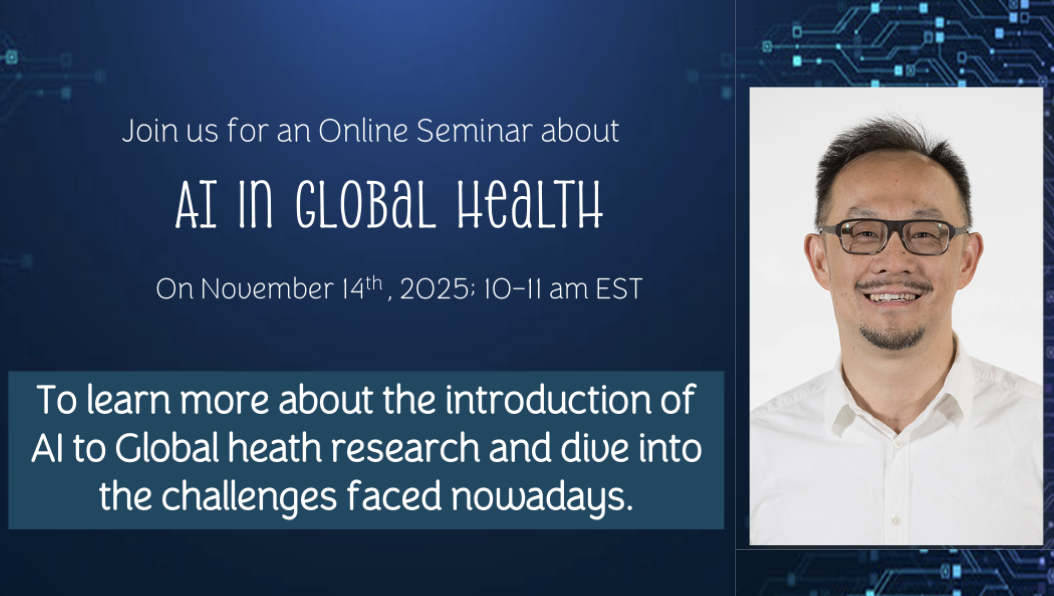
The Global Health Research Collaborative (GHRC) continues its goal of fostering high-impact, accessible, global health education with its latest seminar on “AI in Global Health Research,” held on September 26th via Zoom. This session was part of the GHRC ongoing seminar series, which offers bimonthly sessions designed for graduate trainees, medical professionals, and global health practitioners worldwide. Each seminar yields expert perspectives, and interactive discussions in a fashion that is typically a 45 minute presentation followed by 15 minute Question and Answers (Q&A). All in all, the seminar series creates a space where participants across continents can engage with leading voices in global health.
The seminar titled, “AI in Global Health Research” featured Dr. Dongxiao Zhu, a professor of computer Science at the University of Wayne State University. He is co-director of AI and Data Science, founding director of the Wayne AI research initiative, and director of the trustworthy AI lab. In this seminar, Dr. Zhu unpacked how AI has evolved within the global health landscape, what opportunities it brings to both high-income countries (HICs) and low- and middle-income countries (LMICs), and the ethical and logistical challenges that shape its implementation.
Understanding the Role of AI in Global Health Research
I. Current Implementation of AI in GHR
Dr. Zhu began by tracing AI’s origins in global health research, highlighting how today's AI tools influence almost every dimension of global health research, from disease detection to data management, surveillance, drug discovery, and health systems optimization. Notably, multimodal sensing for disease surveillance has been made possible by AI, facilitating imaging interpretation and treatment plan.
II. Developing I tools for GHR
The workflow of developing AI tools consists of first defining a problem followed by identifying relevant data sources. Next, developing and training AI models using machine learning techniques. Then, validating the models using real-world data. The last steps consist of deploying the tools in clinical settings and monitoring their performance followed by allowing feedback and new data.
III. Challenges and Ethical Considerations
In the seminar, Dr, Zhu then details how AI comes with its own unique set of challenges. For one, developing and deploying AI tools can be expensive and limited resources may hinder the adoption of AI technologies. Furthermore, in order to effectively train AI, there needs to be access to high-quality data for AI to learn from and a team to be able to deploy that information. Lastly, Healthcare professionals need training to use AI tools effectively.
Additionally, it is noteworthy to acknowledge that AI comes with its own biases, which may lead to unfair and discriminatory outcomes. There is also the impact of misuse of AI technologies. Lastly there is a consequence of human anatomy that AI leads to, which is why we must address these ethical issues. Additionally, we must implement strong data encryption in order to protect patient data and keep patients anonymous.
IV. Conclusion and Future Directions
Overall, Dr. Zhu emphasizes that AI is a multifaceted technology with many dimensions to consider. While it has already accelerated discovery and improved accuracy in global health research, its full impact will depend on continued partnership, innovation, and responsible use.